Slowing Biological Aging With Everyday Habits
The DO-HEALTH trial shows vitamin D, omega-3s, and simple exercise can modestly slow biological aging. Learn how to apply it joyfully after 60.
Bruce R Black
12/29/20254 min read
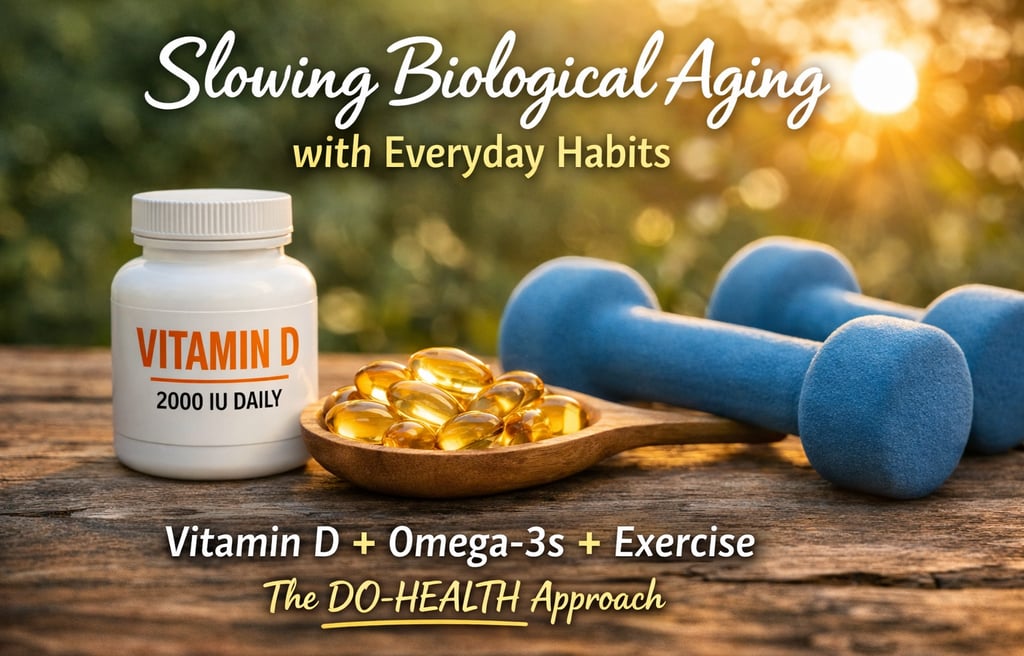
Slowing Biological Aging With Everyday Habits
What the DO-HEALTH Trial Tells Us (and Why This Is Great News)
If you’ve ever wished aging came with a user manual, good news: science is slowly writing one.
And the latest chapter doesn’t involve ice baths, fasting until you hallucinate, or buying supplements that cost more than your first car.
Instead, it involves three refreshingly ordinary things:
Vitamin D
Omega-3s
Simple, regular movement
Together, they showed measurable effects on biological aging in a large, well-run clinical trial called DO-HEALTH.
Yes—measurable. As in, scientists looked at markers inside the body that reflect how fast we’re aging at the cellular level…and saw improvement.
Let’s talk about what that actually means, what the study found, and how to apply it with joy, not pressure.
Chronological Age vs. Biological Age (Why the Candles Lie)
Your chronological age is how many birthdays you’ve survived.
Your biological age is how worn your cells feel about it.
Two people can both be 70:
One feels spry, steady, sharp, and energetic
The other feels stiff, foggy, and exhausted by Tuesday
Same age. Very different biology.
Biological age is influenced by:
Inflammation
Muscle mass
Hormone balance
Mitochondrial function
Nutrient status
Movement (or lack of it)
And here’s the hopeful part: biology is modifiable.
That’s where DO-HEALTH comes in.
What Was the DO-HEALTH Trial?
DO-HEALTH was a large, randomized controlled trial involving over 2,000 adults aged 70 and older across five European countries.
That already makes it rare. But it gets better.
Instead of testing one magic pill, researchers tested three everyday interventions, alone and in combination:
Vitamin D (2,000 IU/day)
Omega-3 fatty acids (1 gram/day)
A simple home exercise program (strength + balance)
Participants were followed for three years, and researchers looked at outcomes related to:
Physical function
Falls
Infections
Bone health
And, later, biological aging markers
This wasn’t about extreme fitness or elite athletes.
This was about real people living real lives.
The Big Finding (In Plain English)
When researchers analyzed biological aging markers (using epigenetic “clocks”), they found:
👉 The combination of vitamin D + omega-3s + exercise modestly but measurably slowed biological aging.
Not reversed.
Not frozen in time.
But nudged in the right direction.
And in longevity science, that’s a big deal.
Because slowing aging—even a little—can mean:
Fewer chronic diseases
Better mobility
Sharper cognition
More years of independence
All without doing anything extreme.
Why These Three Work So Well Together
This is where it gets interesting. Each habit helps on its own—but together, they cover all the major aging systems.
1. Vitamin D: The Quiet Multitasker
Vitamin D isn’t just about bones.
It plays roles in:
Immune regulation
Muscle function
Inflammation control
Gene expression
Low vitamin D levels are linked with:
Weakness
Falls
Poor immune resilience
Faster functional decline
In DO-HEALTH, adequate vitamin D acted like a foundation nutrient—not flashy, but essential.
Think of it as oiling the hinges so everything else moves better.
2. Omega-3s: Anti-Inflammatory Peacekeepers
Omega-3 fatty acids (especially EPA and DHA) help calm chronic inflammation—the low-grade kind that accelerates aging from the inside.
They support:
Cardiovascular health
Brain function
Muscle protein synthesis
Cell membrane integrity
Inflammation speeds up biological aging.
Omega-3s gently apply the brakes.
Not dramatically. Not overnight.
But consistently.
3. Simple Exercise: The Master Switch
Movement is the only intervention that touches every system at once.
The DO-HEALTH exercise program wasn’t fancy:
Strength
Balance
Functional movements
Done at home
A few times per week
This kind of exercise:
Preserves muscle mass (critical after 60)
Improves insulin sensitivity
Boosts mitochondrial function
Reduces fall risk
Signals your body: “We still need this machinery.”
Exercise is the loudest anti-aging signal your body understands.
The Magic Is the Combination
Here’s the key takeaway most headlines miss:
No single habit was a miracle.
The combination was the message.
Vitamin D supports muscle and immune function
Omega-3s reduce inflammatory drag
Exercise tells your body to rebuild instead of retreat
Together, they create a pro-maintenance environment.
That’s how you slow aging—not by fighting time, but by cooperating with your biology.
What This Means for Active Agers (and Real Humans)
You do not need to:
Biohack your blood
Track 12 biomarkers
Optimize every hour of your day
DO-HEALTH suggests something far kinder:
👉 Stack small, reasonable habits—and let time work for you instead of against you.
This fits perfectly with the Beat Age With Ease philosophy.
A Joyful, DO-HEALTH-Inspired Routine
Here’s how to translate the science into a week that feels doable.
Daily
Vitamin D (check with your clinician for dose)
Omega-3 supplement or fatty fish
Walk, stretch, or move a little
2–3× Per Week
Strength work (bodyweight, bands, light weights)
Balance exercises (single-leg stands, heel-to-toe walks)
Most Days
Gentle activity you enjoy
(walking, gardening, dancing, rebounding, playing with grandkids)
And yes—our 10-minute Beat Age With Ease workout fits beautifully.
Short. Consistent. Joint-friendly. Effective.
Why “Modest Benefits” Are Actually Huge
You might see phrases like:
“Small but significant.”
“Modest slowing”
“Incremental improvement”
That’s not a disappointment.
That’s how real aging intervention works.
A 1–2% slowdown in biological aging, compounded over years, can mean:
Delayed onset of disease
Extended independence
More good years before things get hard
Longevity isn’t about immortality.
It’s about stretching the good part.
What This Study Does Not Say (Important!)
Let’s keep our feet on the ground.
DO-HEALTH does not say:
Supplements alone will save you
Exercise can be skipped
Aging can be stopped
More is always better
It says:
Simple habits matter
Consistency beats intensity
Biology responds to kindness
That’s a message worth repeating.
Aging With Ease, Not Anxiety
One of the quiet gifts of this research is psychological.
It tells us:
You’re not behind.
You didn’t miss your chance.
You don’t need to “catch up.”
Starting now still matters.
Whether you’re 60, 70, or 80+, your body is listening.
The Bottom Line
The DO-HEALTH trial gives us something rare in longevity science:
Reassurance.
You don’t need to overhaul your life.
You don’t need extremes.
You don’t need fear.
Just:
Nourish your body
Move it gently but regularly
Support it with a few smart basics
Aging is inevitable.
How fast it happens is negotiable.
And the negotiation starts with everyday habits—done with joy, not force.
“Look for practitioner-grade omega-3s that provide ~1,000 mg EPA + DHA per day, are third-party tested, and clearly list EPA and DHA amounts — not just ‘fish oil.’”
As always, check with your healthcare provider — especially if you’re on blood thinners or managing a medical condition.
These are the ones I use from my
Fulscript store
© 2025. All rights reserved.
"Disclaimer: The fitness and exercise information provided on this website is intended for educational purposes only. It is not a substitute for professional medical advice, diagnosis, or treatment. Consult your physician or a qualified health provider before starting any exercise program. The use of any information provided on this site is solely at your own risk. We do not assume liability for any injuries or health issues that may result from using our content."